Here’s a masterpost of my Japanese posts I’ve made so far. For newer posts and posts made by other langblrs please check my Japanese-tag. You may like/reblog this post if you want to, but I would really appreciate if you liked/reblogged individual posts instead!
Please note that some posts are from my old blogs, I’m not stealing/claiming other people’s posts as mine!
In lieu of a ‘how to
study’ Japanese post, here’s a few online resources which have helped me with
studying Japanese throughout the years.
The resources listed
below;
Range from beginner’s level to advanced level
Are appropriate for studying for the JLPT (N4- N1)
Are appropriate for self study
Most are free, or come with a free trial period! (excluding textbooks. but trust me, i’ve got your back)
Essential Websites and Extensions
IN RIKAIKUN WE TRUST
Rikaikun:The one-stop shop for all your browsing
needs. Hover over any kanji compound and this app will do all the translating
for you. I found this incredibly useful for reading practice (esp. on news
articles etc.).
Jisho.org: One of the best dictionaries out there. Sorts most kanji according to JLPT
level.
Tofugu:A good general starting place to find resources and read interesting articles about Japanese culture, ex-pats working in Japan and Studying in Japan. They also have a special series on applying for the JET Program!
Grammar
Particles? Verbs? Subjects? Conjugations?
JGram:All grammar is sorted by JLPT Levels. A good overview of common grammar structures.
@ryohkei is a Japanese
calligrapher who handwrites beautiful characters + stroke order and
definitions. Very informative, given that handwritten kanji may differ from their typed counterparts.
* But I advise you to watch LearningJapanese!! Like this guy literally taught me from Kana to Intermediate Grammar, which has been a very good improvement
Read actual news! Furigana makes it easy and the shortness of the articles prevents you from getting overwhelmed. As an added bonus, the articles can be read aloud if you want.
Awesome blog that’s fun and informative. They seem to be the most up-to-date on what study methods actually work. Also post a lot about Japanese culture.
Haven’t used these much yet but they seem to be unsubtitled educational videos which is great for listening practice. Simpler Japanese since they’re for kids 🙂
Awesome daily magazine subscription. Similar to NHK News Web Easy but way more content and a good variety of content. Real news but also comics, pop culture stuff, and funny advertisements. Furigana-included.
You can get so much for free on this site that I don’t know why you would pay. Fantastic listening practice. Listen to it to natural, slow and bilingual variants to practice and check yourself. SO many audio clips. Fun dialogues
Everyone knows this one but I use it so frequently I had to include it. I love how you can search in romaji, kanji, hiragana, or katakana. Thoroughly benri ;D
Here’s a master post for video lessons #51-#100 in the Learning Japanesevideo series, all view-able for free on YouTube! That’s right, each topic gets its own episode! All arranged in order and linked below. Check out all 200+ video lessons at the official YouTube channel here and the other Master Posts: 13
Single Sentence Summary: A website where you post journal entries in your target language, native speakers correct it and vice versa.
Why You Should Use It:NATIVE. SPEAKERS. CORRECTING. YOUR. ENTRIES!!!! It also has an abundance of native Japanese speakers which is always a plus and forces you to actively utilise what you’ve learnt vs. your knowledge just passively withering away.
Possible Pitfalls: Correcting other people’s grammar is weirdly addictive and you might find yourself spending hours on it or maybe that’s just me whoops.
Single Sentence Summary: A web browser add-on that automatically translates Japanese if you hover over words.
Why You Should Use It: It’s extremely useful when reading articles online, especially when it comes to unknown kanji. It provides an efficient way to access definitions.
Possible Pitfalls: They’re potentially a little too helpful – you could get reliant on them and not actually learn the kanji D:
Single Sentence Summary: A site filled with Japanese lessons taught by ‘Maggie Sensei’, a French bulldog.
Why You Should Use It: The grammar lessons are really helpful as they provide a lot of context rather than just telling you how to form the structure. Maggie Sensei is also ridiculously cute.
Possible Pitfalls: I don’t actually use it on a super regular basis so I’m not sure how many resources there actually are, but the explanations I HAVE used from the site are all A+.
Single Sentence Summary: Japanese newspapers written with simple vocabulary and grammar that are aimed towards children.
Why You Should Use It: Because the articles are aimed towards children, they’re much easier to digest and take in. Also keeps you up to date with how awful the world is haha 😉
Possible Pitfalls: The articles all come with furigana above basically ALL the kanji which can get a tad annoying. If you’re looking for something more challenging, consider trying the original newspapers such as The Daily Asahi and NHK News.
Listening
Japanese Youtubers //
Native Japanese speakers with English subtitles:PDRさん
Native Japanese speakers without English subtitles:MAHOTO //
Non-native Japanese speakers with English subtitles:MIMEI
Note: There are probably plenty more Youtubers out there but for time and convenience’s sake, I’ve only listed the ones that a) make videos mainly in Japanese and b) I actually watch myself.
Why You Should Use It: Youtube videos are short and snappy so they don’t take up as much time as say, watching a film. Furthermore, because a lot of them are humorous, you can pick up more natural sounding phrases.
Possible Pitfalls: You might get sucked into an irredeemable blackhole of no return and never leave your house again.
Japanese Anime, Dramas and Variety Shows //
Why You Should Use It: Dramas/anime/variety shows come in episodes so they are also quick and easy to watch. COVER THE SUBTITLES (or better yet, have no subtitles) so you’re actually learning from the experience, not just wasting time. Don’t hesitate to replay sections again if you didn’t quite catch everything the first time.
Disclaimer: Anime characters (and certain drama characters) say some pretty weird stuff so please use your common sense when picking up phrases. DO NOT run around screaming 「だってばよ」 like Naruto or referring to yourself as「
俺様
」just because Atobe from Prince of Tennis does. Always check that what you’re learning is actually applicable to real life.
Possible Pitfalls: See the disclaimer above. Also just as a general rule, slice-of-life stuff tends to have more vocabulary that you can actually use in real life for obvious reasons.
Single Sentence Summary: An app that allows you to connect with native speakers of other languages. You can do so by text, audio messages and voice + video calls.
Why You Should Use It: Essentially you can practice reading, writing, speaking and make new friends all at the same time. What’s not to love?
Possible Pitfalls: This is a minor thing but I keep forgetting to reply on HelloTalk because I want to reply properly but I never have the time to do so. Apart from that it’s been great so far. 🙂
Single Sentence Summary: An all-purpose forum about Japanese culture but it’s particularly useful for finding language learning partners.
Why You Should Use It: As stated above, it’s good for finding penpals and language learning partners. You can filter by age, gender, country, language etc. which is pretty good. Also, all messages are sent through the site so on the off chance that you do meet a creepy weirdo, they won’t have access to your contact details.
Possible Pitfalls: Since all the messaging is done through the website, I tend to forget to check my inbox a lot of the time. Also they automate the passwords which makes them easy to forget too. For these reasons, I would recommend messaging on LINE or something once you’ve ascertained the other party isn’t a serial killer or something along those lines. 😉
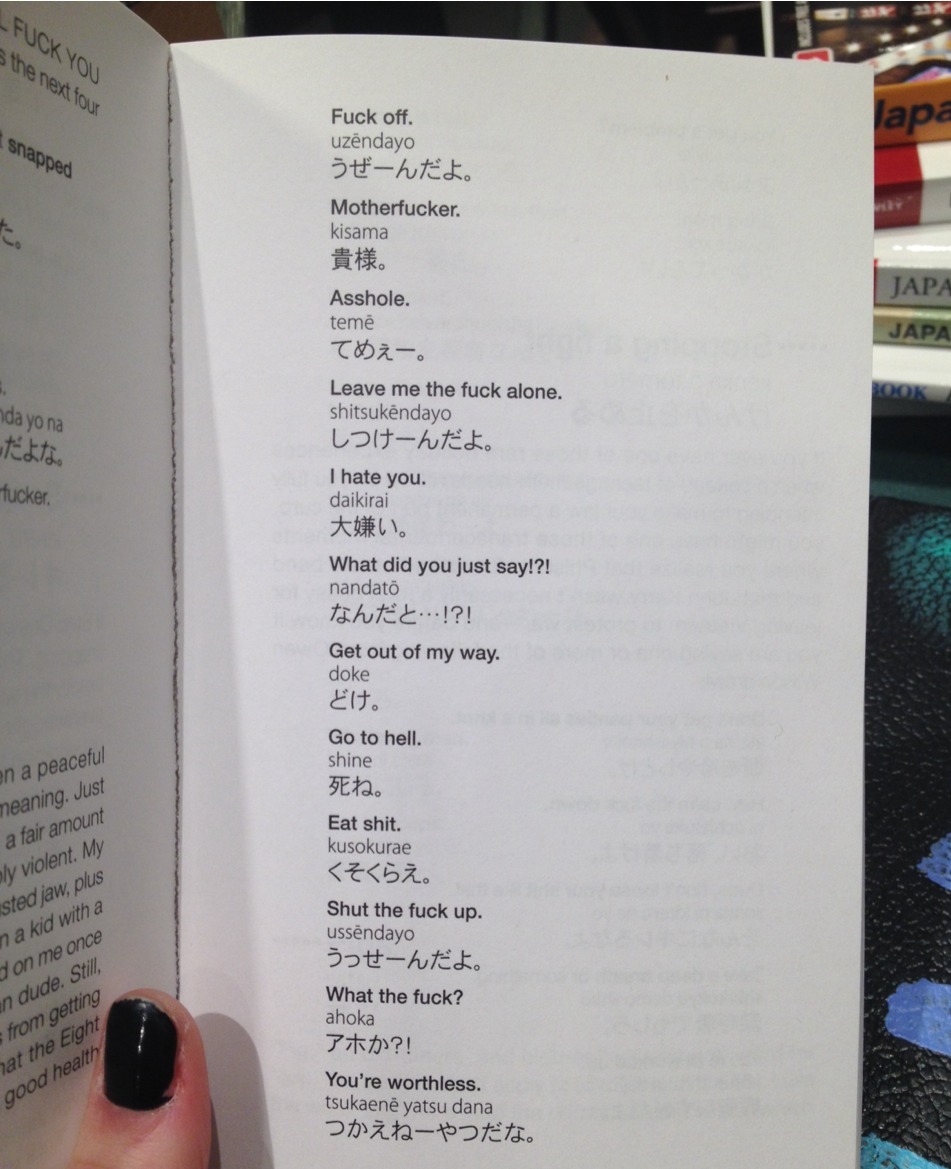
Anyone else read this with the stereotypical Japanese “punk” accent?
I didn’t just read it in the accent. I felt the accent.
i
絶対必要な単語。w
Also good ones:
ざけんなよ。 zakenna yo. You gotta be fucking kidding me.
そんなばかな! sonna baka na! That’s ridiculous!
出てけ。 deteke. Leave.
何ってたか、てめえ?特殊作戦群の卒業クラスでは一番だった俺は無数のアルカイダに反して極秘の使命に関わったし、公認キルは300人以上なんだぞ。游撃戦兵で、自衛隊の最高の狙撃兵だ。てめえなんてありがたりの目標、それだけ。間違いない、この世に見たことない正確にぶっこわすぞ。ネットでそんな悪い口なんて許せると思うのか?考えなおせ。話しながら日本中のスパイネットワークを呼んで、IPをたどってるので、嵐のために準備を。生活と言う可哀想さの殲滅を持ってくる嵐だ。お前はもう死んでいる。 nan tte ta ka, temee? tokushu sakusengun no sotsugyou kurasu de wa ichiban datta ore wa mukou no arukaida ni hanshite gokuhi no shime ni kuwatta shi, kounin kiru wa sanbyakunin ijou na n da zo. yuugeki senbei de, jietai no saikou no sogekihei da. temee nante arigatari no mokuhyou, sore dake. machigai nai, kono yo ni mita koto nai seikaku ni bukkowasu zo. Netto de sonna waruiguchi nante yuruseru to omou no ka? kangae naose. hanasinagara nihonchuu no supai nettowaaku wo yonde, IP wo tadotteru no de, arashi no tame ni junbi wo. seikatsu to iu kawaisousa no senmetsu wo mottekuru arashi da. omae wa mou shindeiru. What the fuck did you say about me you little bitch? I graduated top of my class in the JSDF Special Forces Group, and I’ve been involved in countless secret missions against Al-Quaeda, and I have 300 confirmed kills. I’m trained in gorilla warfare, and I’m the top sniper in the entire Self Defense Force. You are nothing but just another target. Make no mistake, I’ll wreck you with precision the likes of which has never been seen before on this Earth. You think I’ll let you get away with saying shit like that on the internet? Think again. As we’ve been speaking, I’ve contacted my network of spies across Japan, and your IP is being traced, so get ready for the storm. The storm which will annihilate the pathetic thing you call your life. You’re already dead.







 refessence