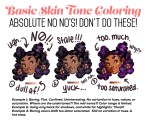
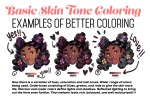
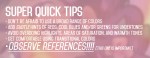
Someone asked for a few tips regarding coloring skin tones so I threw this together real quick lol.
Obviously not an end all, be all — and in NO WAY covers the plethora of info regarding this topic. Just a quick guide from my perspective. One day I’ll make a tut more extensive and organized with way better examples 😭
completely double spaced version on google docs here – this post is more blocky for the sake of people’s dashboards, but still long so people will be less likely to glaze over it. my apologies if that makes it hard to read
things to look for and avoid in an autistic character
• symptoms only manifesting as “nonverbal and rocking”
• super smart / living calculator
• super dumb / doesn’t understand anything
• all the symptoms you can come up with for them are “awkward” and “has special interest(s)” (please do more research)
• trains, technology, and/or math as special interests
• acting like a child
•
getting treated like a baby
• unreasonably cruel and uncaring about others’ reactions to them being cruel
• if they’re comparable to sheldon from the big bang theory, start over
• animal comparisons
• a lack of feelings
• please no stories about what it’s like to be autistic told by allistics
talking about things outside of special interests (again…. come on……….) (special interests are usually the default things our brains go to when theres no stimulation or we want to entertain ourselves – it isn’t literally all we think or talk about ever. if a conversation has no connections to a special interest, reconsider having your autistic character bring it up in a context that is not an introduction.)
•
explicitly expressed to be capable of attraction and romantic feelings – if your character is an adult, add sexual feelings to this point
•
capable of general functioning, just with a disability that makes it more difficult – not a walking disability (….sigh)
• a wide amount of feelings and emotional turmoil (but perhaps only being able to express it in limited ways)
• we’re people
• just people whose brains are wired differently
things to avoid in research for an autistic character
•
autism moms / autism blogs and websites not run by autistic people
•
any affiliation with autism $peaks means you should walk away and never look back
•
a scientist trying to create explanations for what autistic people do without actually asking / not mentioning asking autistic people
• anything about a cure for autism
• a person that “worked with autistic kids” phrased in the same way as “worked with animals”
• talking about autistic people as if they are mysteries, are like animals, or are otherwise othered weirdos instead of people
things to look for in research for an autistic character
•
actual autistic people talking about their experiences and symptoms
• just stick to that and you’re good but it’s hard to find sometimes ngl. just look for the above red flags
things i would personally like to see in an autistic character
• less easy to swallow sadness and more destructive anger. i would love to see a canonically autistic character who was frustrated easily by small things and had trouble communicating why •
not a story about being autistic, a story that happens to have a character or characters who are autistic – it isn’t pointed out or questioned, they’re right at home with the rest of the cast and not othered (a la symmetra from overwatch) •
intensive sensory issues / small sounds making large reactions • clear communications about not liking x sensory thing (for example being touched) •
poor motor skills / clumsiness and not being laughed at for it • walking funny (body bent downwards, walking very fast, walking slowly,
big strides, shuffling, stiffness, etc) – no one treats it as if it’s funny or something totally strange • a big personality that has a presence so they can’t be cast aside (but feel free to have quiet characters too) – if this was along with being nonverbal they would probably leap to being one of my favorite characters ever • a fear of asking for clarification on sarcasm or jokes because of past experiences and an arc about the character becoming more comfortable asking questions
>> if any fellow autistic people want to add something, feel free <<
So if a porn bot reblogs and puts a link to your selfies you can do this
SO IF A PORN BOT PUTS A LINK TO A PORN SITE/VIRUS YOU CAN FOLLOW THESE STEPS TO HAVE IT REMOVED. ALSO IF ANY REMOVES THE ORIGINAL CAPTION OF YOUR POST TO BOOST THEIR BLOG YOU CAN REPORT THEM (AND GET THEM REMOVED) TOO.
YOU CAN ALSO FILE A DMCA (Digital Millennium Copyright Act) AGAINST THEM TOO. http://tumblr.com/dmca
Trying to learn a second language? This list of amazing YouTube channels for learning languages and understanding their cultures will provide you with quality learning experiences and entertainment. Check out these channels to get started:
I wanted to recolor something but didn’t want to do it manually (I’m lazy…I know…but hey its cool) so here are two ways I learned to recolor grey scale art
1. Gradient Maps
In Photoshop, go to Image > Adjustments > Gradient Map
Here, you can apply preset gradients to your pieces by selecting them in the drop down.
(There are some rather interesting choices, as you can see from the random one I selected)
By clicking the gradient bar itself, you can edit the gradient you have selected, create a new one, or load in other presets. Just make sure the gradient type is Solid and not Noise, it won’t let you edit the colors if it is set to Noise. This method is helpful if you’re doing a palette challenge.
Here’s some of the results I got messing around with it:
2. Prisma
Prisma is amazing. Its and app, I thiiink it’s originally made to edit instagram picures, but it can do a lot more than that
You select a picture in the app, and from there you can select and test out different styles on it. Some work better on certain works than others do, experiment a bunch. Each one takes a couple minutes to load, but its worth it
Here’s some of the styles I liked:
I’m sure you could combine both of these methods, but I haven’t tried that yet. Could be interesting
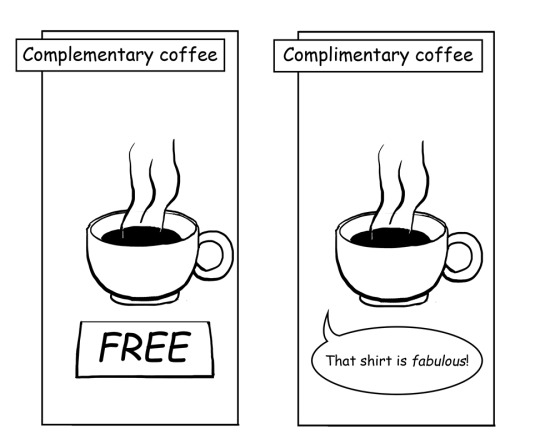
IF IT HAS BEEN A VERY LONG DAY, YOU ARE ‘WEARY’. IF SOMEONE IS ACTING IN A WAY THAT MAKES YOU SUSPICIOUS, YOU ARE ‘WARY’.
ALL IN ‘DUE’ TIME, NOT ‘DO’ TIME
‘PER SE’ NOT ‘PER SAY’
THANK YOU
BREATHE – THE VERB FORM IN PRESENT TENSE
BREATH – THE NOUN FORM
THEY ARE NOT INTERCHANGEABLE
WANDER – TO WALK ABOUT AIMLESSLY
WONDER – TO THINK OF IN A DREAMLIKE AND/OR WISTFUL MANNER
THEY ARE NOT INTERCHANGEABLE (but one’s mind can wander)
DEFIANT – RESISTANT DEFINITE – CERTAIN
WANTON – DELIBERATE AND UNPROVOKED ACTION (ALSO AN ARCHAIC TERM FOR A PROMISCUOUS WOMAN)
WONTON – IT’S A DUMPLING THAT’S ALL IT IS IT’S A FUCKING DUMPLING
BAWL- TO SOB/CRY
BALL- A FUCKING BALL
YOU CANNOT “BALL” YOUR EYES OUT
AND FOR FUCK’S SAKE, IT’S NOT “SIKE”; IT’S “PSYCH”. AS IN “I PSYCHED YOU OUT”; BECAUSE YOU MOMENTARILY MADE SOMEONE BELIEVE SOMETHING THAT WASN’T TRUE.
THANK YOU.
*slams reblog*
IT’S ‘MIGHT AS WELL’. ‘MIND AS WELL’ DOES NOT MAKE GRAMMATICAL SENSE.
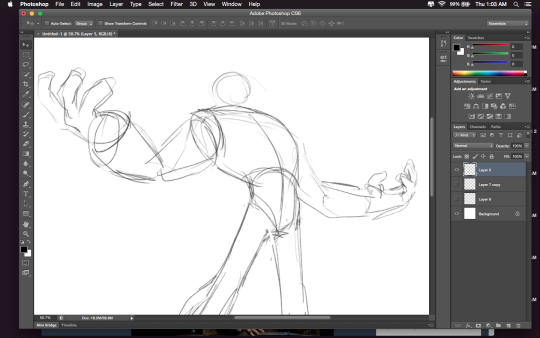
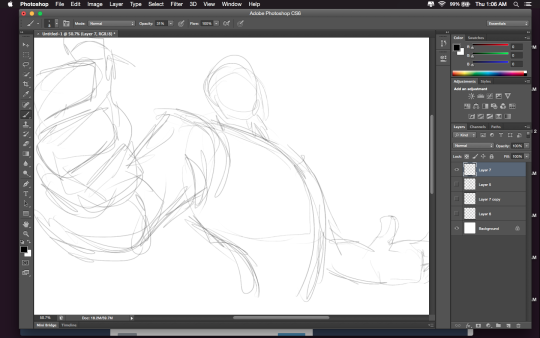
For those wondering about HOW to do this, here’s a short explanation according to me:
Drawing A to Drawing B: -the most obvious change is the exaggeration of the line of motion in the character.
In Drawing B the line of motion is much more pronounced, creating more drama and movement to the whole composition
-The arms are open wider, showing more confidence and exuberance in the character, exaggerating their emotions so they can be more clearly read without having to look to the face for emotional cues.
-the legs are wider apart, adding to the aforementioned confidence but also giving the character a solid foundation, visually speaking.
-The head is tilted back and overlapped by the chest, adding a touch of dynamic perspective to the drawing.
Drawing B to Drawing C: -Most obvious change is to zoom in on the character. Character framing is just as important as what the character is doing. Zooming in can help infensify emotions. this shot is ALL about this character and what they’re feeling. -Because of the zooming in, the arms/hands would have gotten lost, so instead of making the canvas wider, the artist has elected to rotate the character slightly, bringing a dynamic angle to things and more intensity to the close shot. -While the character is more upright in this shot compared to Drawing B, in Drawing C the chest still slightly overlaps the neck, preserving the feeling of being slightly below the character (putting them in a position of power relative to the viewer), which helps maintain confidence and power in the character. -the chest is exaggerated to carry the majority of the body’s line of action so even though you cannot see the legs, our brains are able to fill in the gap and envision that line of action. -The cropping/framing of the character allows for a more interesting composition/negative shapes created by the positive (character) on the negative (background), creating more visual interest as well as a circular motion to the composition through the arms, across the face to the negative space for the eyes to rest in before dropping to the hand in the background and back through the composition again.
DID YOU DISSECT MY DRAWING TO FIND OUT WHY IT WORKS?? I LOVE YOU. I LOVE YOU. THANK YOU SO MUCH