hiii. so here’s a list of some recipes (and other baking/cooking-related things) that i’ve found through tumblr, pinterest and google! i hope you find this helpful. i’d really appreciate if you checked out my blog, or maybe even give it a follow? anyways, all links open in new tabs!
OH MY GOD whyyyy did no one tell me you’re supposed to send thank-yous after interviews?? Why would I do that???
“Thank you for this incredibly stressful 30 minutes that I have had to re-structure my entire day around and which will give me anxiety poos for the next 24 hours.”
I HATE ETIQUETTE IT’S THE MOST IMPOSSIBLE THING FOR ME TO LEARN WITHOUT SOMEONE DIRECTLY TELLING ME THIS SHIT
NO ONE TOLD YOU???? WTF! I HAVE FAILED YOU.
Also:
Dear ______:
Thank you so much for the opportunity to sit down with you (&________) to discuss the [insert job position]. I am grateful to be considered for the position. I think I will be a great fit at [company name], especially given my experience in __________. [insert possible reference to something you talked about, something that excited you.] I look forward to hearing from you [and if you are feeling super confident: and working together in the future].
My brother got a really great paid internship one summer. The guy who hired him said the deciding factor was the professional thank you letter my brother sent after the interview.
should it be an email? or like a physical letter?
email, you want to send it within a few hours at max after the interview if you can so it’s fresh in their mind who you are.
Confirmed! I interviewed for a job right after arriving in NY. The interview went incredibly well, and I went home and immediately wrote a thank you letter and put it in the mail. I had a super good feeling about this interview.
I didn’t get the job.
However, a few weeks later, I was called in to interview with another editor in the same company, and I did get that job. I found out later from the initial editor (the one who didn’t hire me) that he had planned to offer me the job, but since I didn’t follow up with a thank you letter, he assumed I didn’t really want it. He offered the job to another contender–but when he got my letter in the mail shortly after the offer had already been made, he went to HR and gave me a glowing recommendation. It was based on that recommendation that I got called in for the second interview.
So: send an email thank you immediately (same day!) after the interview. If you’re feeling extra, go ahead and send a written one too. OR go immediately to a coffee shop, write the letter, and return to the office and give it to the secretary.
Either way, those letters are important.
Pro tip: If you really want HR to develop a personal interest in your application, publicly thank them on linkedin. Just make a short post telling your network about how X recruiter really went above and beyond to make you feel welcome, or about how be accommodating and professional they were, or whatever. Make sure to use the mention feature so they’ll get a notification and see it.
Flattery will get you everywhere… and public flattery that might make its way back to their manager, doubly so.
Obligatory plug for one of FreePrintable.net’s sites: ThankYouLetter.ws. They have a whole section with interview thank you letter templates, and a page with specific tips for interview thank you letters. (There are also tons of other letter templates if you browse around a bit.)
hello i am here today to not lose track of the art cheats i have discovered over the years. what i call art cheat is actually a cool filter/coloring style/way to shade/etc. that singlehandedly makes art like 20 times better
A small list of random ass sites I’ve found useful when writing:
Fragrantica: perfume enthusiast site that has a long list of scents. v helpful when you’re writing your guilty pleasure abo fics
Just One Cookbook: recipe site that centers on Japanese cuisine. Lots of different recipes to browse, plenty of inspiration so you’re not just “ramen and sushi”
McCormick Science Institute: yes this is a real thing. the site shows off research on spices and gives the history on them. be historically accurate or just indulge in mindless fascination. boost your restaurant au with it
Cocktail Flow: a site with a variety of cocktails that’s pretty easy to navigate and offers photos of the drinks. You can sort by themes, strengths, type and base. My only real annoyance with this site is that the drinks are sometimes sorted into ~masculine~ and ~feminine~ but ehhhh. It’s great otherwise.
Tie-A-Tie: a site centered around ties, obviously. I stumbled upon it while researching tie fabrics but there’s a lot more to look at. It offers insight into dress code for events, tells you how to tie your ties, and has a section on the often forgotten about tie accessories
Even more:
Types of High Heels: A page describing twenty five different types of high heels. It gives a description and pictures. Shake it up from just “stilettos and kitten heels”
Random Job Generator: Exactly as it says. The site offer more generators like characters, plots, or town names.
Drawing basic facial expressions is not the hardest. Most people can draw a sad face, a happy face, angry etc., but making more multidimensional expressions is more of a challenge. I have gotten a lot of compliments on how I draw facial expressions, (specifically “angsty ones”) telling me that they are very dramatic and well… expressive! And there are actually only a few things I think about when I draw faces that take them to the next level, so I thought i’d illustrate them all here!
SUPER IMPORTANT TIP BEFORE WE START: Look at your own face when you draw faces. Even making the face when you are drawing (you don’t even have to look at it), will give you some sense of how the face muscles pull and where things fold and stretch, because you can feel it. You are the best reference when it comes to facial expressions!
Angles
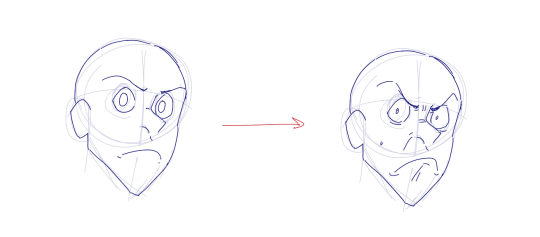
Draw the head in an angle that matches the expressions you want to make. It is not a requirement, but is going to add to the effect.
Symmetry vs asymmetry
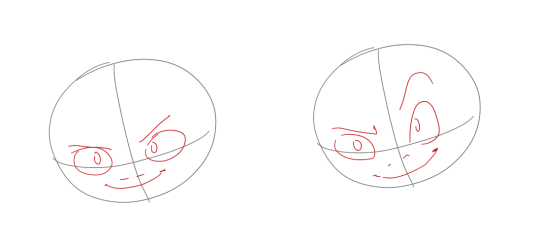
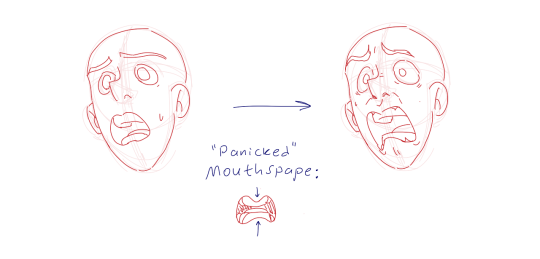
A face is rarely symmetric. Unless the face the character is making is 100 % relaxed or even dissociating, the eyebrows, mouth and facial muscles will have different placements of their respective side. This image shows the dramatic impact asymmetry has on a face:
That’s the difference between a smile and a smirk!
The first one’s like “oh yeah?” and the second is like “oH YEAH??”
The “balloon squishing principle”
This is something I did subconsciously, and I didn’t know about until I made this tutorial. And this principle goes hand in hand with an asymmetric face. Basically, if you squish one part of the face, you need to even out the empty space by “inflating” the other part of the face so that it doesn’t appear shrunken. The picture hopefully explains it:
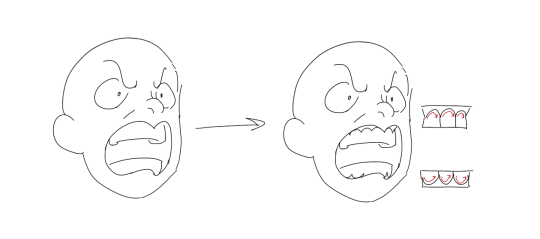
Teeth
Don’t forget to add the gum when the mouth is open to its full potential!
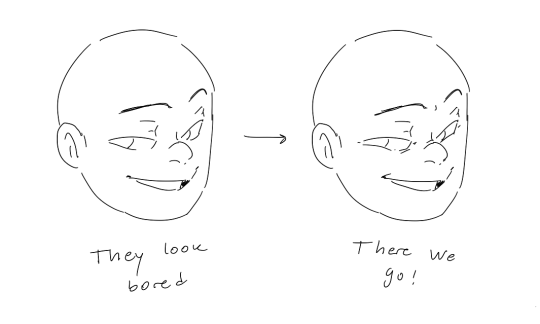
Squinting and folding
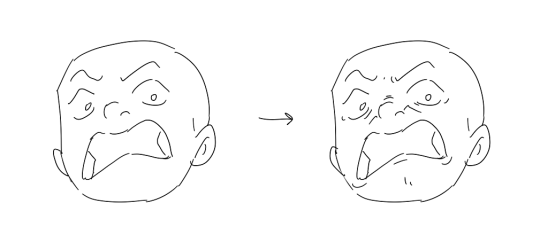
Adding folds around the eyes when a character is squinting makes a HUGE difference. It makes a smile more genuine and a growl more intimidating. Adding folds to the face in general makes your characters more lifelike and ‘visually relatable’. Like, they look human, and less plastic or fake.
and so on..
Pupils and irises
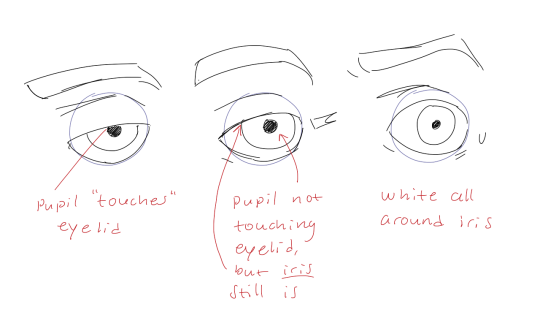
The placement of the iris and pupil in relation to the eyelids is very important! The less of the white you see, the more relaxed the character is.
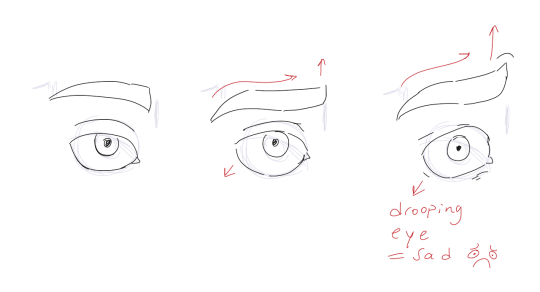
And then of course eyebrows and eyes go hand in hand!
Gestures, spitting, sweating…
Adding more elements than just a face is key to making the character actually look like they are feeling what you want them to feel. Just the tiniest sweat drop adds to their anxiety, spitting adds frustration to their rage, slouching shoulders, waving hands, a double chin, extreme angles, the list goes on! Add whatever and see what kind of impact it makes! Does it do the trick? Great! Add it!
Over exaggeration!!
Remember that you can almost always exaggerate more. Don’t be afraid to do draw “too much” because you’re just experimenting. See what works and what doesn’t. What do you like to exaggerate?
Now that you know some theory, it’s time to practice!
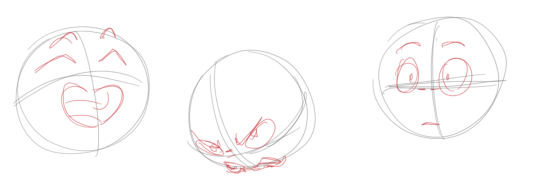
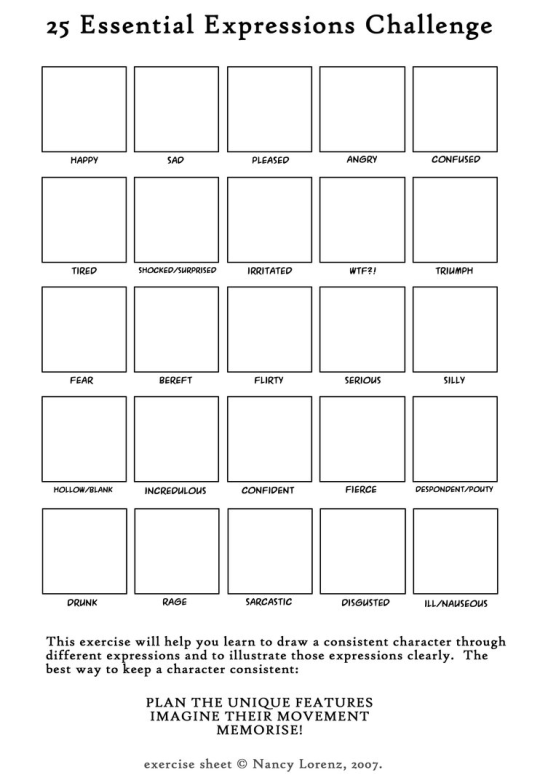
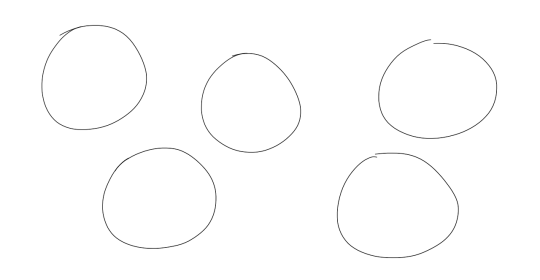
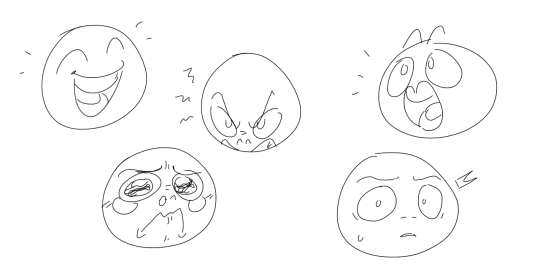
Fill a page with circles and fill them in with different expressions. Try and exaggerate as much as you can!
This is mostly for experimenting. They are quicker to draw than complete faces, but the same rules should apply!
And that’s about it!
I don’t know if I covered everything in this tutorial, since some things might be obvious for me, and this post perhaps only scratches the surface. So feel free to send me a message if you want an explanation about something more in depth! Thank you for reading! And now DRAW!!! ✨🎨
👏👏👏
Wonderfully detailed guide on drawing facial expressions. definitely go and follow @elvirasteckningar!
Okay before anything else, I would like to clarify that these tips help me. These are techniques that work for me. If they don’t work for you or they’re not your style, then don’t fret! (That doesn’t in any way imply that you can’t get your life together.) If you find that these tips aren’t for you, don’t force yourself to follow them! These are just gentle suggestions that you may or may not try out! I hope you guys enjoy!
What’s this post about?
Sometimes we just reach that point in our daily living where we’re so overwhelmed by almost everything that we don’t really know where to start or what to do. In this post, I just wanna give some suggestions that might help you sort out the things you need to do! There’ll also be some handy links at the end of the post!
1. Tie your hair and put on a new shirt.
You will feel much much much better after fixing up your hair and putting on something fresh. No, it won’t clear the skies or feed all of Africa, but it will set an “I can accomplish a lot” mood. You’ll be at your most productive state if you just feel good in general. And if not good, at least fresh. Wash your face, comb your hair, brush your teeth, drink water, etc. TAKE A SHOWER. Wash away the stress and scrub the burdens off your shoulder. You’ll feel really motivated to get down to work, believe me.
2. Clean your room.
Now that your freshening up has (hopefully) motivated you to get some stuff done, straighten up your room or study/work space. Your environment has a direct effect on your productivity according to several studies and articles like this one. If you work in an organized and clean area, your productivity levels will surely go up! Really take the time to go through your old belongings. Put everything in its proper place. Get rid of old clothes that you don’t wear anymore (honey, if you haven’t worn it in 6 months, you’re never gonna wear it). Make sure also that you maintain it (easier said than done, I know). Cleaning your room will also help you gradually get into a working mood, so it’ll be easier for you to start working on other tasks.
TIP: Play some fun and peppy music while you’re cleaning your room for an extra mood boost.
3. Write out everything in your mind.
Sit down and get comfy. Pull out any piece of paper, can be anything from an old receipt to your favorite stationery pad. Now write. Write down…
everything you have to do urgently, in the near future, in the far future. > e.g. finish an assignment, set up an appointment with the dentist, get into college/find a job
anything that’s bothering you or lingering in your mind > e.g. how your crush just followed you back on twitter, how scary it is to send an email to adults
things that you absolutely cannot forget > e.g. return that library book, friend’s bday is coming up soon (gotta get a gift!), there’s an important test coming up
thoughts, feelings, opinions, irrelevant things > e.g. school’s tiring you out, politics are driving you nuts, the stray cat on your road seems kinda hungry today
JUST WRITE THEM ALL. In my opinion, it’s better to have your thoughts all laid out visible on paper rather than having them swimming in and out of your mind. Once they’re on paper, you can let your mind rest a bit from holding in so much information. Don’t write your thoughts in any particular order. Just write your ideas as they pop into your head. It may seem unsystematic for some of you, but just wait until the next point!
4. Organize your mind.
Now get a clean sheet of paper and organize your thoughts—tasks, dates, ideas/opinions, misc.
Tasks: Hopefully you’ve heard of the Eisenhower Box. If not, do not fear, for I will explain it!
So make this nifty table on your new sheet of paper, and organize your tasks accordingly! But first, expand. If you have quite abstract tasks like “get into college” break these tasks into smaller tasks like “review for entrance exams” or “fill out application,” and then classify those tasks into the table.
after categorizing your tasks, make a to-do list! (There are many ways to make a to-do list. What I usually do is start with the easy/fun tasks first then list the more challenging/time-consuming ones last. However, this is up to you! Explore what works for you.)
Dates: Have you considered investing on those really big wall calendars? You should!! Get a big wall calendar and hang it up in your room so you can see it every morning and every night. Fill in the dates with appointments, test days, deadlines, birthdays, and anything else! Having a calendar will help you visualize how much time you have left before a certain event. If you can’t get a calendar, other alternatives include a planner, your phone calendar, and/or an online calendar (like Google calendar).
Ideas/Opinions: I’d recommend using a journal (traditional or digital) to keep a record of your thoughts! It’s very good to clear your mind of these if you wanna delegate more of your thinking powers on another task. You can also talk to other people! Maybe you’ve been really bothered by something happening in your life that you really wanna let out. Look for trustworthy companions that you can confide in. After a long hearty talk, you’ll be ready to conquer the day once again!
Misc: Anything else that hasn’t been covered in the previous categories can be written here. It’ll be for you to decide how to proceed with these notes.
Other Resources: Check out these other links/masterposts for more tips on how to get your life together! (highly recommended links are italicized)
And of course, don’t push yourself. If you need to take a break, go! Sleep. Reenergize your body. This period won’t last forever, and one day you’ll find yourself laughing at this actually short amount of time where you were stressing over the world’s end. Trust me.
Single Sentence Summary: A website where you post journal entries in your target language, native speakers correct it and vice versa.
Why You Should Use It:NATIVE. SPEAKERS. CORRECTING. YOUR. ENTRIES!!!! It also has an abundance of native Japanese speakers which is always a plus and forces you to actively utilise what you’ve learnt vs. your knowledge just passively withering away.
Possible Pitfalls: Correcting other people’s grammar is weirdly addictive and you might find yourself spending hours on it or maybe that’s just me whoops.
Single Sentence Summary: A web browser add-on that automatically translates Japanese if you hover over words.
Why You Should Use It: It’s extremely useful when reading articles online, especially when it comes to unknown kanji. It provides an efficient way to access definitions.
Possible Pitfalls: They’re potentially a little too helpful – you could get reliant on them and not actually learn the kanji D:
Single Sentence Summary: A site filled with Japanese lessons taught by ‘Maggie Sensei’, a French bulldog.
Why You Should Use It: The grammar lessons are really helpful as they provide a lot of context rather than just telling you how to form the structure. Maggie Sensei is also ridiculously cute.
Possible Pitfalls: I don’t actually use it on a super regular basis so I’m not sure how many resources there actually are, but the explanations I HAVE used from the site are all A+.
Single Sentence Summary: Japanese newspapers written with simple vocabulary and grammar that are aimed towards children.
Why You Should Use It: Because the articles are aimed towards children, they’re much easier to digest and take in. Also keeps you up to date with how awful the world is haha 😉
Possible Pitfalls: The articles all come with furigana above basically ALL the kanji which can get a tad annoying. If you’re looking for something more challenging, consider trying the original newspapers such as The Daily Asahi and NHK News.
Listening
Japanese Youtubers //
Native Japanese speakers with English subtitles:PDRさん
Native Japanese speakers without English subtitles:MAHOTO //
Non-native Japanese speakers with English subtitles:MIMEI
Note: There are probably plenty more Youtubers out there but for time and convenience’s sake, I’ve only listed the ones that a) make videos mainly in Japanese and b) I actually watch myself.
Why You Should Use It: Youtube videos are short and snappy so they don’t take up as much time as say, watching a film. Furthermore, because a lot of them are humorous, you can pick up more natural sounding phrases.
Possible Pitfalls: You might get sucked into an irredeemable blackhole of no return and never leave your house again.
Japanese Anime, Dramas and Variety Shows //
Why You Should Use It: Dramas/anime/variety shows come in episodes so they are also quick and easy to watch. COVER THE SUBTITLES (or better yet, have no subtitles) so you’re actually learning from the experience, not just wasting time. Don’t hesitate to replay sections again if you didn’t quite catch everything the first time.
Disclaimer: Anime characters (and certain drama characters) say some pretty weird stuff so please use your common sense when picking up phrases. DO NOT run around screaming 「だってばよ」 like Naruto or referring to yourself as「
俺様
」just because Atobe from Prince of Tennis does. Always check that what you’re learning is actually applicable to real life.
Possible Pitfalls: See the disclaimer above. Also just as a general rule, slice-of-life stuff tends to have more vocabulary that you can actually use in real life for obvious reasons.
Single Sentence Summary: An app that allows you to connect with native speakers of other languages. You can do so by text, audio messages and voice + video calls.
Why You Should Use It: Essentially you can practice reading, writing, speaking and make new friends all at the same time. What’s not to love?
Possible Pitfalls: This is a minor thing but I keep forgetting to reply on HelloTalk because I want to reply properly but I never have the time to do so. Apart from that it’s been great so far. 🙂
Single Sentence Summary: An all-purpose forum about Japanese culture but it’s particularly useful for finding language learning partners.
Why You Should Use It: As stated above, it’s good for finding penpals and language learning partners. You can filter by age, gender, country, language etc. which is pretty good. Also, all messages are sent through the site so on the off chance that you do meet a creepy weirdo, they won’t have access to your contact details.
Possible Pitfalls: Since all the messaging is done through the website, I tend to forget to check my inbox a lot of the time. Also they automate the passwords which makes them easy to forget too. For these reasons, I would recommend messaging on LINE or something once you’ve ascertained the other party isn’t a serial killer or something along those lines. 😉
-a writing interface that encourages you to write 750 words (about three pages) every day, and allows you to analyse your writing. my personal favourite.


















 refessence